
In recent years, Japan has embarked on a historic modernization of its defense capabilities, moving away from strictly defensive postures to embrace long-range standoff strike capabilities. As part of a record $55 billion defense budget request for fiscal year 2027, the Japanese government has unveiled plans to develop and mass-produce a new generation of low-cost cruise missiles by 2030. This strategic pivot is driven by regional security concerns, the tactical necessity of overwhelming modern air defenses, and the economic realities of sustaining a deep munitions stockpile.
The Deterrence Imperative
Japan’s strategic calculus is fundamentally shaped by the rapidly deteriorating security environment in the Indo-Pacific. With China rapidly expanding its naval and air assets—coupled with its assertive posture in the East China Sea and around Taiwan—and North Korea continuing to advance its ballistic missile programs, Tokyo has recognized the need for a credible deterrent. In the past, Japan relied almost entirely on the United States for offensive strike capabilities. Now, building an indigenous counterstrike capability is a central pillar of its national security strategy.
The Tactics of Overwhelming Volume
The most notable aspect of this new initiative is the emphasis on low-cost systems. Modern warfare has demonstrated that even the most advanced multi-million-dollar air defense interceptors can be rapidly depleted by large swarms of relatively inexpensive drones and cruise missiles.
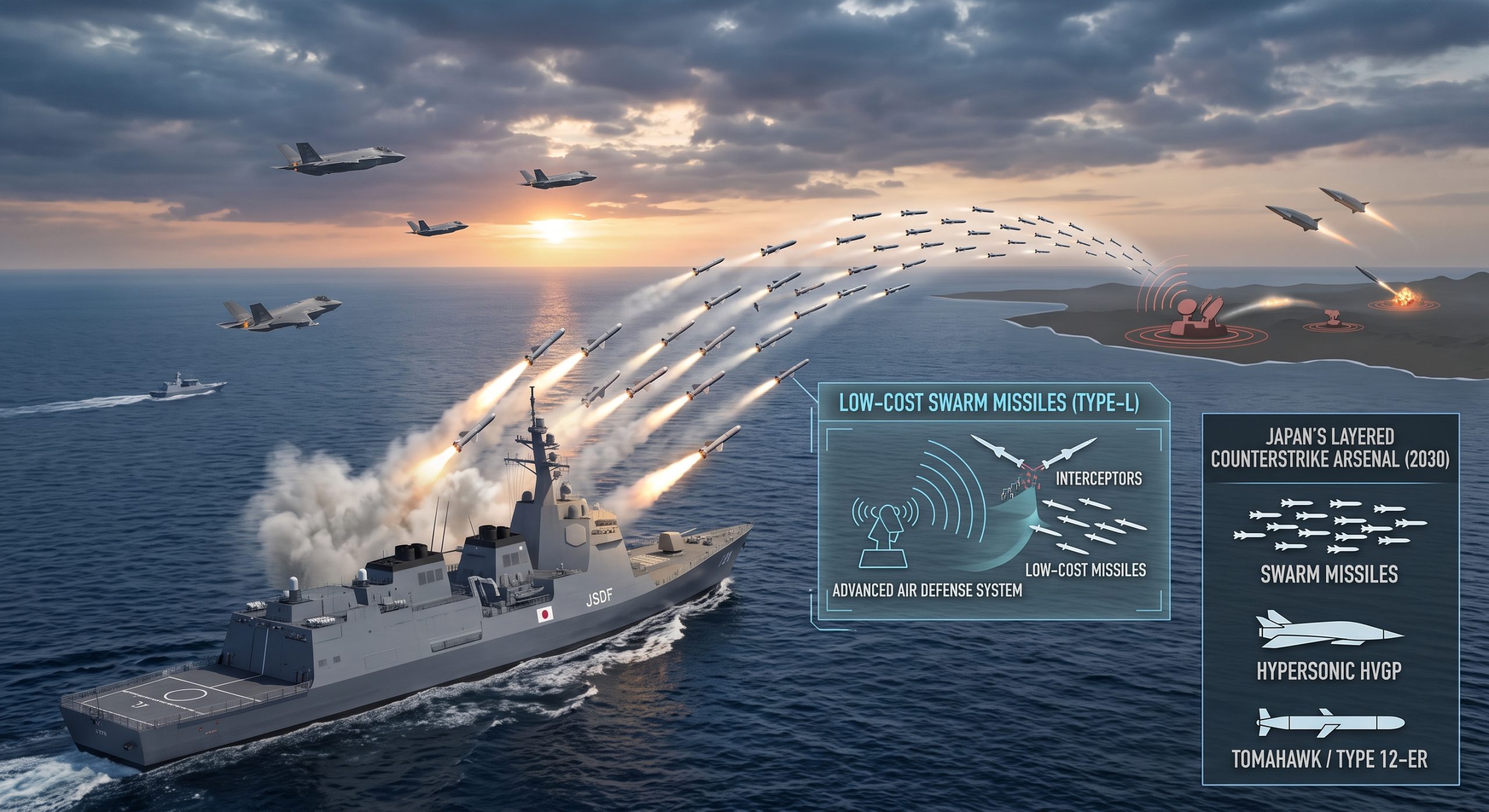
By developing low-cost cruise missiles, Japan is adopting a strategy of volume. The goal is to field a massive inventory of munitions capable of overwhelming adversary air and missile defense networks. If a conflict were to erupt, launching large salvos of inexpensive missiles could saturate enemy radars and interceptors, paving the way for high-value, advanced strike assets to reach their targets. This approach prevents adversaries from easily neutralizing Japan’s counterstrike capabilities through attrition.
Building a Layered Arsenal
These low-cost cruise missiles are not meant to replace Japan’s high-end acquisitions, but rather to complement them. Japan’s current missile procurement strategy is highly layered, including:
-
Foreign Acquisitions: The purchase of U.S.-made Tomahawk cruise missiles to provide an immediate, proven long-range strike capability.
-
Upgraded Domestic Systems: The extended-range modification of the ground- and sea-launched Type 12 anti-ship missiles, and the newly designated Type 25 long-range systems.
-
Advanced Next-Gen Weapons: Heavy investments in high-velocity glide projectiles (HVGPs) for island defense and hypersonic guided missiles to evade traditional interception.
By integrating a lower tier of affordable cruise missiles into this mix, the Japan Self-Defense Forces (JSDF) can reserve their scarce, sophisticated weapons—like hypersonic gliders and stealthy standoff missiles—for the most critical and heavily fortified strategic targets.
Economic and Industrial Autonomy
Cost constraints play a significant role in this development. Modern standoff missiles are incredibly expensive, making it fiscally impossible to build a deep stockpile using only top-tier systems. By designing a missile optimized for mass production and lower unit costs, Japan ensures it can maintain sufficient inventory levels to sustain prolonged deterrence. Furthermore, developing this system domestically stimulates Japan’s defense industrial base, reducing reliance on foreign supply chains that could become congested or compromised during a regional crisis.
Japan’s decision to develop low-cost cruise missiles by the end of the decade represents a pragmatic adaptation to the realities of modern conflict. By recognizing that quantity has a quality of its own, Tokyo is ensuring that its newly acquired counterstrike capabilities are deep enough to be taken seriously. As these systems move toward mass production in 2030, they will form the backbone of a more assertive and resilient Japanese defense posture in the Pacific.