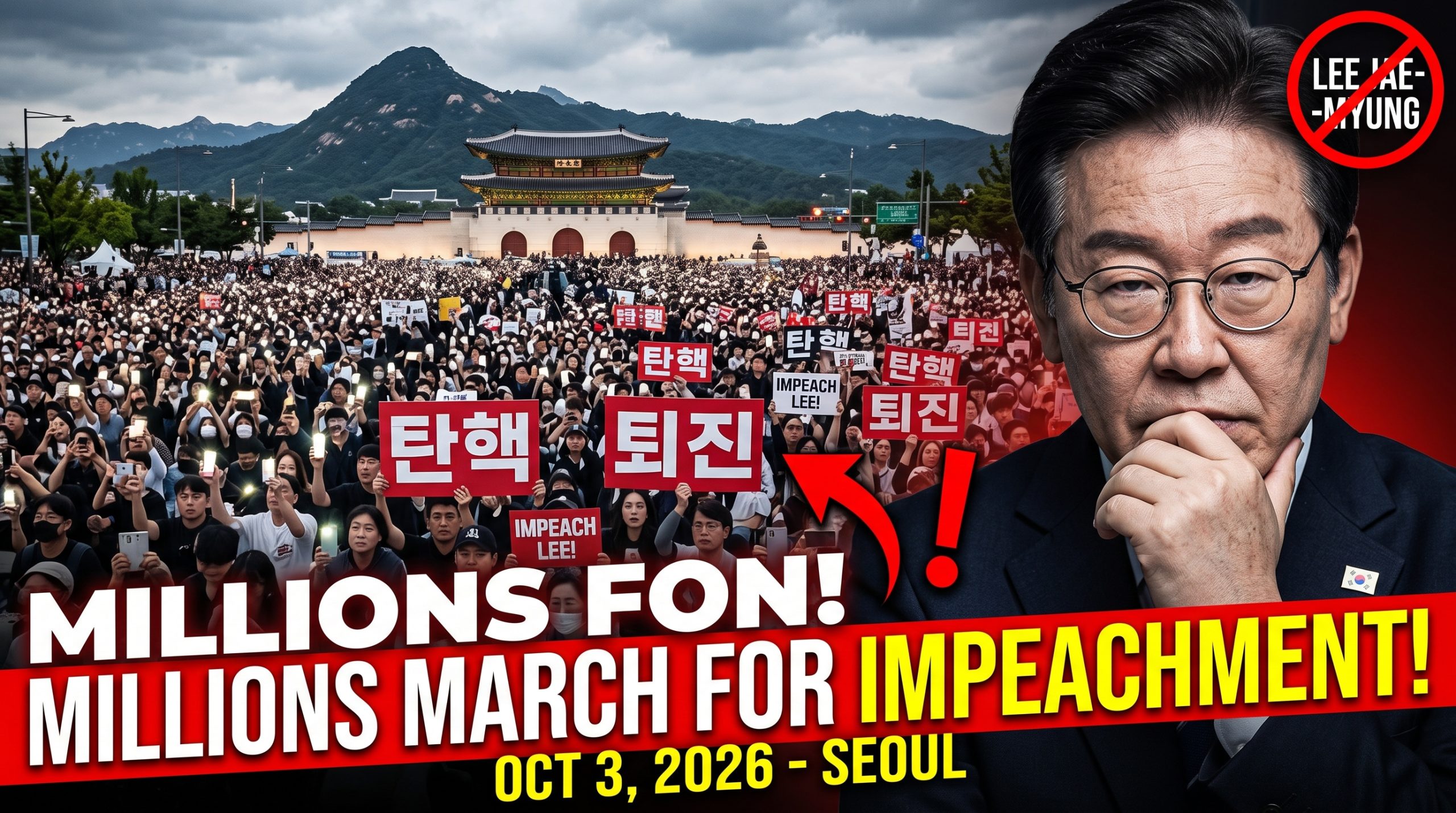

SEOUL (Oct 4, 2026) — On October 3, coinciding with South Korea’s National Foundation Day, massive crowds flooded central Seoul to protest the policies of President Lee Jae-myung. Organized by the main opposition People Power Party (PPP), the “National Action Rally to Judge the Lee Jae-myung Administration” saw tens of thousands of citizens and nearly 70 opposition lawmakers gather in front of Sungnyemun Gate.
While some opposition voices claimed attendance swelled into the hundreds of thousands, official party estimates placed the crowd at around 200,000, whereas police estimated the number closer to 10,000. Regardless of the exact headcount, the demonstration marked the most significant street mobilization against President Lee’s administration to date, with PPP leadership openly floating the prospect of his impeachment.
The outrage fueling the protests stems from a convergence of crises spanning national security, sweeping judicial reforms, economic policies, and the president’s own communication style. Here is a breakdown of why protesters and opposition leaders are demanding President Lee’s ouster:
1. National Security and the DMZ Mine Incident
The most immediate catalyst for the protest was the administration’s handling of a recent North Korean provocation. On September 21, a landmine explosion in the Demilitarized Zone (DMZ) injured three South Korean soldiers, two of them seriously.
Rather than formally condemning Pyongyang, President Lee referred to the incident as an “unfortunate accident” and an “unforeseen accident,” failing to directly name North Korea. This soft stance drew public ire, which intensified when Kim Yo-jong, the powerful sister of North Korean leader Kim Jong-un, mocked Seoul’s response as a “self-staged farce.” Following her statement, North Korea provocatively fired a ballistic missile. PPP leader Jang Dong-hyeok lambasted the president, stating that Lee “begged North Korea for peace even on Armed Forces Day” and warned that if he continues to defy public sentiment, “the only path left for President Lee Jae-myung is impeachment.”
2. Prosecution Reforms and “Shielding Criminals”
Another major grievance centers on the administration’s aggressive overhaul of the judiciary and prosecution service. The government recently pushed through reforms that stripped the prosecution of its supplementary investigative powers—essentially closing its investigative doors for the first time in 78 years.
The PPP argues this has created a massive public safety void. At the rally, PPP floor leader Chung Jom-sig declared that a “cabinet of criminals has created a paradise for criminals,” directly accusing President Lee of utilizing the reforms to “make his own trials disappear.”
3. Economic Mismanagement and “State Violence” Against Farmers
On the domestic front, the administration has faced severe backlash over a recent nationwide “farmland survey.” Five-term PPP lawmaker Na Kyung-won took to Facebook to describe the sweeping initiative as a “new tenancy farming system” where the state seeks to act as a mega-landlord. She condemned the survey as “state violence that plunders farmers’ private property.”
Furthermore, the government has been heavily criticized for a series of recent bank hacking incidents suspected to involve North Korean cyber units. The opposition accused the administration of severe negligence, noting that protecting the financial information of the public is a fundamental pillar of national security.
4. “Social Media Rhetoric” Politics
Adding fuel to the fire is President Lee’s communication strategy. Lawmakers and protesters expressed deep frustration over Lee’s tendency to govern via social media rather than direct public engagement.
Recently, Lee took to X (formerly Twitter) using the unusual expression “jwa-ah-hage” to urge the public to promote his state affairs achievements. Opposition members advised the president to immediately suspend his social media activities, urging him to instead “step into the lives of the people and vividly listen to the voices of angry public sentiment.”
As the National Assembly prepares for its parliamentary audit, the People Power Party is utilizing the momentum from the October 3 rally to apply maximum pressure on the administration. With tensions with North Korea escalating and domestic polarization deepening, the calls for President Lee’s impeachment signal a turbulent political season ahead for South Korea.