
The longstanding geopolitical rivalry between the United States and Iran escalated into a full-scale crisis in early 2026, culminating in the effective closure of the Strait of Hormuz. As the world’s most critical maritime chokepoint for energy transit, the standoff has disrupted global supply chains, heavily impacted international shipping, and ignited a severe global fuel crisis.
The Catalyst and the Blockade
While tensions between Washington and Tehran trace back to the 1979 Iranian Revolution and historic maritime skirmishes like the 1980s “Tanker War,” the current conflict erupted in February 2026 following U.S. and Israeli military operations against Iranian targets. In retaliation, Iran’s Islamic Revolutionary Guard Corps (IRGC) announced on March 27 that the strait was officially closed to any vessels traveling to or from the U.S., Israel, and their allied nations.
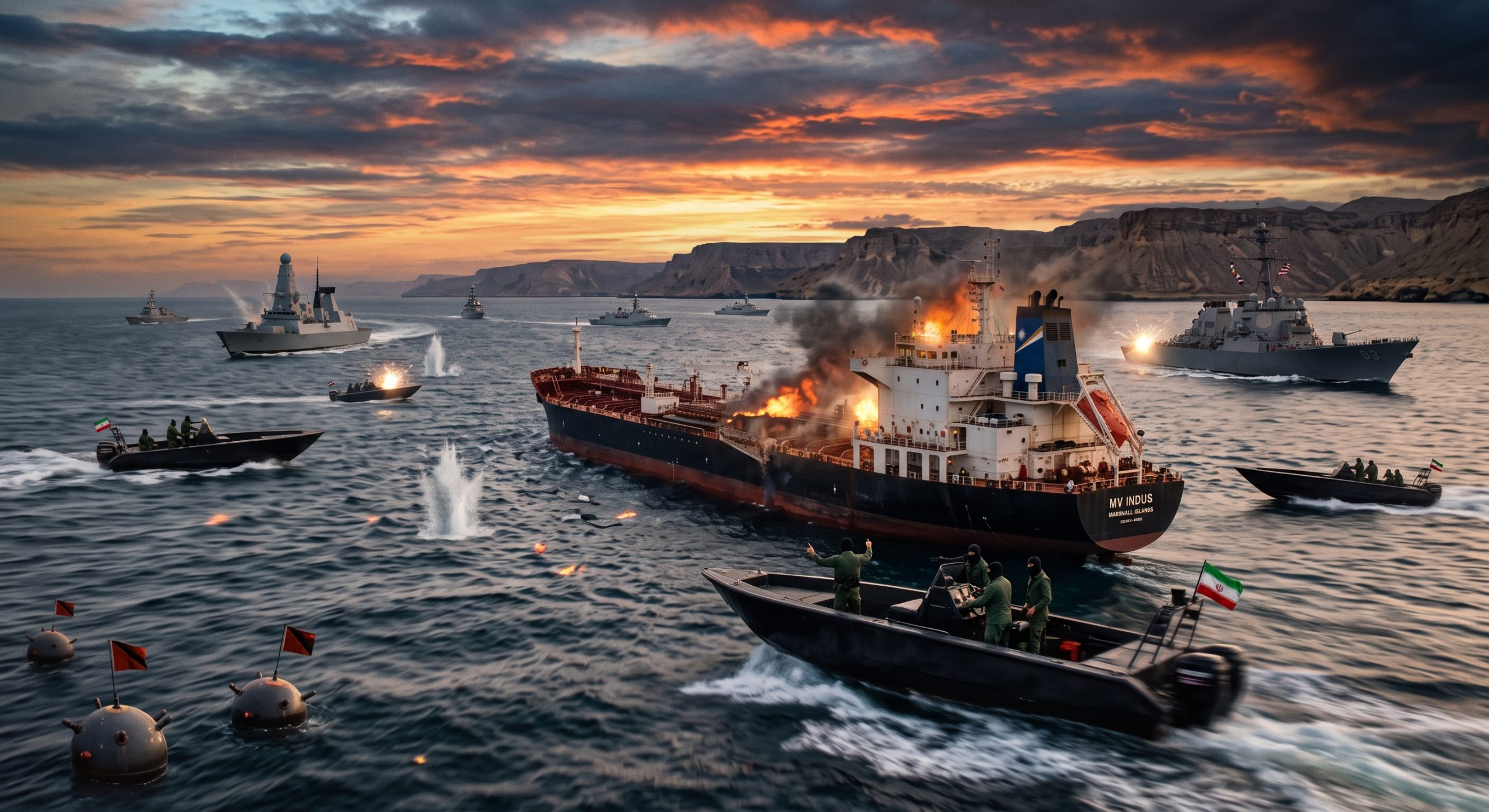
To enforce this closure, the Iranian military has utilized naval harassment, sea mines, and drone swarms. Recent escalations into October 2026 include direct projectile strikes on oil vessels transiting the strait. In response to the blockade, the U.S. military initiated a counter-blockade of Iranian ports, launched an aerial campaign against Iranian targets along the strait, and began naval escort operations to protect commercial shipping.
Clashing Geopolitical Doctrines
At the heart of the standoff are two irreconcilable legal and territorial claims that have deadlocked diplomatic efforts.
-
The United States: Washington and its allies maintain that the Strait of Hormuz is an international transit corridor. Relying on established maritime law, they demand unrestricted freedom of navigation and toll-free passage for all global shipping.
-
Iran: Tehran asserts domestic sovereignty over the waterway. The Iranian government claims the legal right to control maritime transit, act as the route’s gatekeeper, and levy transit fees on commercial vessels passing through their territorial waters.
Before the conflict, the strait accommodated approximately 20 million barrels of oil per day—roughly 25% of the world’s seaborne oil trade and 20% of global liquefied natural gas (LNG) shipments. It also served as a major conduit for up to 30% of internationally traded agricultural fertilizers.
Economic and Strategic Fallout
The sheer drop in transit volume—falling from 20 million barrels a day to an estimated 6 to 9 million—has sent shockwaves through the global economy, risking widespread energy market volatility and recession in import-dependent countries.
The crisis has also forced oil-producing nations to seek alternative, often less efficient routes. Saudi Arabia, for example, has drastically increased its East-West pipeline flows to bypass the strait entirely by exporting through the Bab el-Mandeb strait and the Red Sea. However, this rerouting has created new vulnerabilities, as the alternate corridors have been subjected to attacks from regional proxy groups like the Houthis.
The ongoing standoff in the Strait of Hormuz continues to test the limits of international maritime law. With heavy militarization on both sides and shifting global energy logistics, the waterway remains the flashpoint of a broader regional war that relies on a delicate balance of deterrence and brinkmanship.