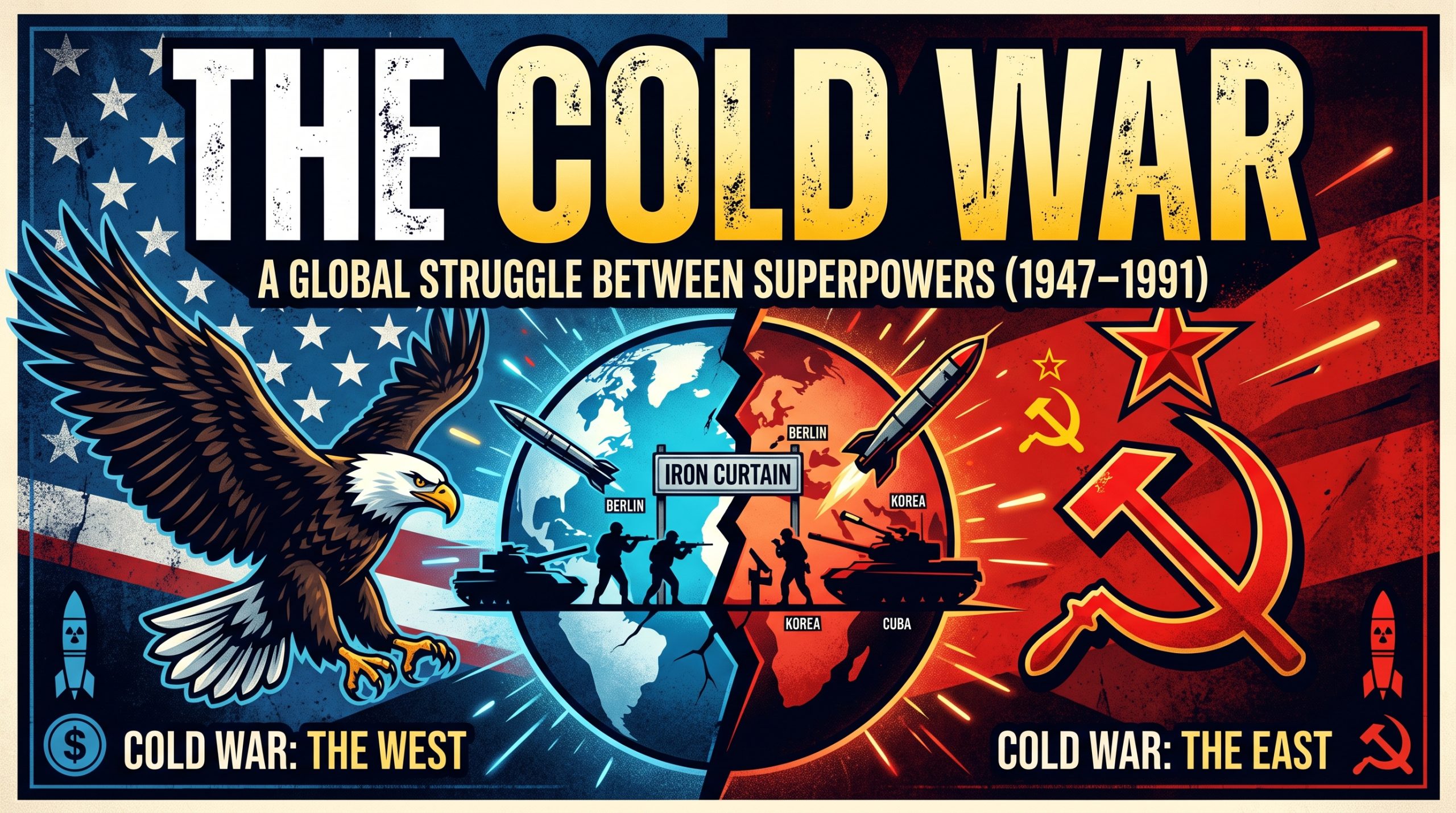

The Cold War was an intense political, economic, and propaganda rivalry between the United States, the Soviet Union, and their respective allies that emerged following World War II. Despite the intense hostility, the conflict saw limited direct use of weapons between the two primary superpowers. The term “Cold War” was first coined by English writer George Orwell in 1945. Orwell used the phrase to describe a predicted nuclear stalemate between massive super-states capable of annihilating one another in seconds. In the United States, American financier and presidential adviser Bernard Baruch was the first to use the term during a speech in 1947.
Origins of the Conflict
The foundation of the Cold War was laid after the surrender of Nazi Germany in May 1945, when the uneasy wartime alliance between the Soviet Union and the Western powers, specifically the United States and Great Britain, began to deteriorate. The Red Army liberated eastern Europe, but the Soviet Union quickly established left-wing, openly communist governments in these countries by 1948. The Soviets aimed to spread communism for ideological reasons and sought to maintain control over eastern Europe to prevent any future threats from Germany. Conversely, the Americans and the British feared that Soviet domination in eastern Europe would become permanent and that communist parties might rise to power in western European democracies. The divide was firmly cemented by 1947 and 1948, as the United States provided aid through the Marshall Plan to secure American influence in western Europe, while the Soviets had installed openly communist regimes in the east.
The Struggle Between Superpowers
The rivalry peaked between 1948 and 1953, a period defined by major global events. The Soviets blockaded the Western-held sectors of West Berlin from 1948 to 1949 without success. In 1949, the United States and its European allies formed a unified military command known as the North Atlantic Treaty Organization (NATO) to counter the Soviet presence, and that same year, the Soviets successfully tested their first atomic warhead, ending the American nuclear monopoly. Tensions escalated further when Chinese communists took control of mainland China in 1949 and when the Soviet-backed North Korean government invaded U.S.-supported South Korea in 1950, sparking the Korean War.
After the death of Soviet dictator Joseph Stalin in 1953, tensions relaxed slightly, but the creation of the Warsaw Pact by Soviet-bloc countries in 1955 and the admission of West Germany into NATO kept the standoff alive. Another intense phase occurred between 1958 and 1962, as both nations developed intercontinental ballistic missiles. The conflict nearly turned into a catastrophic war when the Soviet Union secretly installed missiles in Cuba in 1962, leading to the Cuban missile crisis. The crisis ultimately resulted in an agreement to withdraw the missiles and demonstrated that both sides feared mutual atomic annihilation. This fear led to the signing of the Nuclear Test-Ban Treaty in 1963, which prohibited aboveground nuclear weapons testing. Although direct military confrontation in Europe was avoided, both superpowers engaged in operations to maintain control over their allies, with the Soviets sending troops into East Germany, Hungary, Czechoslovakia, and Afghanistan, while the U.S. intervened in Guatemala, Cuba, the Dominican Republic, Grenada, and Vietnam.
Toward a New World Order
During the 1960s and 1970s, the strict bipolar division of the world began to fracture. A widening split between the Soviet Union and China shattered communist unity, while dynamic economic growth in western Europe and Japan reduced their relative inferiority to the United States. Consequently, smaller countries found more room to resist superpower coercion and assert their independence. The 1970s witnessed a temporary easing of tensions through the Strategic Arms Limitation Talks (SALT), which produced agreements in 1972 and 1979 setting limits on antiballistic and strategic nuclear missiles.
The End of the Cold War
Following a renewed arms buildup in the early 1980s, the Cold War began to break down significantly in the late 1980s under the leadership of Soviet leader Mikhail Gorbachev. Gorbachev sought to democratize the Soviet political system and dismantled the more totalitarian aspects of the government. When communist regimes across eastern Europe collapsed in 1989 and 1990, Gorbachev permitted their fall, leading to the rise of democratic governments in East Germany, Poland, Hungary, and Czechoslovakia, as well as the reunification of Germany under NATO. These reforms ultimately weakened the communist party and shifted power to the constituent republics of the Soviet Union. The Cold War officially concluded when the Soviet Union formally dissolved on December 31, 1991, resulting in 15 newly independent nations and a Russia led by an anticommunist leader.