
In the early months of 2026, long-simmering tensions in the Middle East finally erupted into an unprecedented regional conflict. Stemming from years of hostility over Iran’s nuclear program, failed diplomatic negotiations, and a struggling Iranian economy, the United States and Israel launched a massive preemptive military campaign. This event, known as the 2026 Iran War, shattered the fragile status quo, reshaped the Iranian regime, and sent shockwaves through the global economy.
The Build-Up: A Boiling Point
The animosity leading to the 2026 war traced its roots back to the 1979 Islamic Revolution and the subsequent hostage crisis, creating a deep bedrock of distrust between the U.S. and Iran. By the mid-2020s, this hostility had amplified significantly. Attempts in 2025 and 2026 to renegotiate a nuclear agreement following the collapse of the 2015 Joint Comprehensive Plan of Action (JCPOA) had completely failed.
At the same time, the Iranian regime appeared to be in a weakened state. The country had been severely battered by years of crippling economic sanctions, destabilizing domestic protests, and the geopolitical fallout from the Israel-Hamas War. Furthermore, Iran had suffered damage during a 12-day conflict with Israel in June 2025. Calculating that diplomatic avenues were closed and sensing vulnerabilities in Tehran’s posture, the U.S. and Israel determined that a military solution presented the best opportunity to neutralize Iran’s nuclear ambitions and regional military reach.
Operation Epic Fury Commences
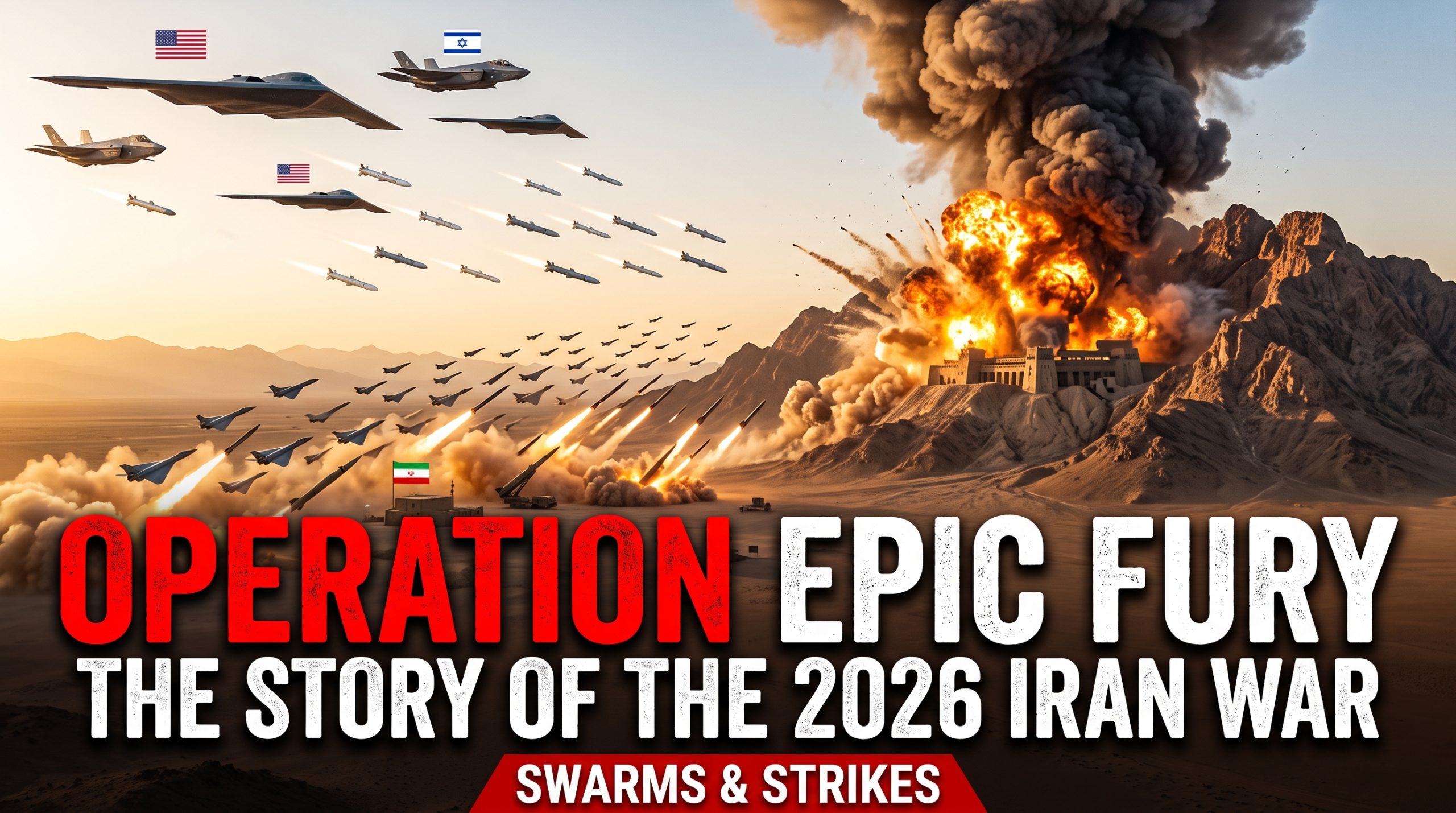
On the mid-morning of February 28, 2026, the United States and Israel launched a devastating joint military campaign codenamed Operation Epic Fury. The initial assault was staggering in its scale: nearly 900 strikes were carried out within the first 12 hours alone.
The primary targets were Iran’s air defenses, missile stockpiles, military infrastructure, and top leadership. The timing was meticulously planned to decapitate the Iranian regime before its leaders could take shelter. The strategy succeeded; Iran’s Supreme Leader, Ayatollah Ali Khamenei, along with dozens of other top Iranian officials, was killed in the first wave of strikes.
However, the opening strikes also led to a devastating civilian tragedy. While attempting to target an Islamic Revolutionary Guard Corps (IRGC) naval base near Bandar Abbas, U.S. forces mistakenly struck an adjacent girls’ school in Minab, killing approximately 170 people.
Iran Retaliates and Regroups
Despite the loss of their Supreme Leader and intense bombardment, the Iranian regime did not collapse. The government swiftly consolidated power under a new cadre of hardliners. Ali Larijani initially stepped in to stabilize the state as the de facto leader before Mojtaba Khamenei, a hawkish figure, emerged to guide the regime.
In response to Operation Epic Fury, Iran unleashed a massive wave of retaliation. Hundreds of missiles and thousands of drones were launched across the Middle East, targeting U.S. embassies, military installations, and crucial oil infrastructure. Iran aimed to inflict steep costs on its adversaries to pressure them into mediation. The resulting exchanges left enormous damage and caused thousands of deaths in Iran and Lebanon, while dozens were killed in Israel and the Gulf Arab states. The violence also triggered massive displacement, severely impacting Lebanon as the Israel-Hezbollah conflict flared up once again.
The Strait of Hormuz and Global Disruption
The intense crossfire severely threatened the Strait of Hormuz, one of the world’s most critical oil chokepoints. The violence disrupted global trade, halted regional flights, and forced international shipping companies to reroute vessels away from the Red Sea and the Strait, leading to fuel shortages across parts of Asia and sending ripples throughout the global economy.
An initial ceasefire encompassing the U.S., Iran, and Israel was reached on April 7–8, but it quickly devolved into a game of brinkmanship specifically focused on the Strait of Hormuz. By June 14, mediators announced a Memorandum of Understanding (MoU) intended to formalize an end to the conflict.
The Ceasefire Cracks
The peace, however, was incredibly fragile. Despite the MoU aiming to reopen the Strait, Iran sought to assert hegemonic control over the waterway, warning ships to follow preapproved routes with the eventual goal of collecting fees. When three commercial vessels bypassed Iran’s strict protocols on July 6–7, Iranian forces attacked them.
In response to these provocations, the United States launched retaliatory strikes against Iranian assets. On July 7, U.S. President Donald Trump declared the June truce to be officially over, and while he initially stated the exchange of fire would not lead to long-term military action, the conflict escalated once again. As of late 2026, the region remained deeply destabilized by this historic, devastating conflict.