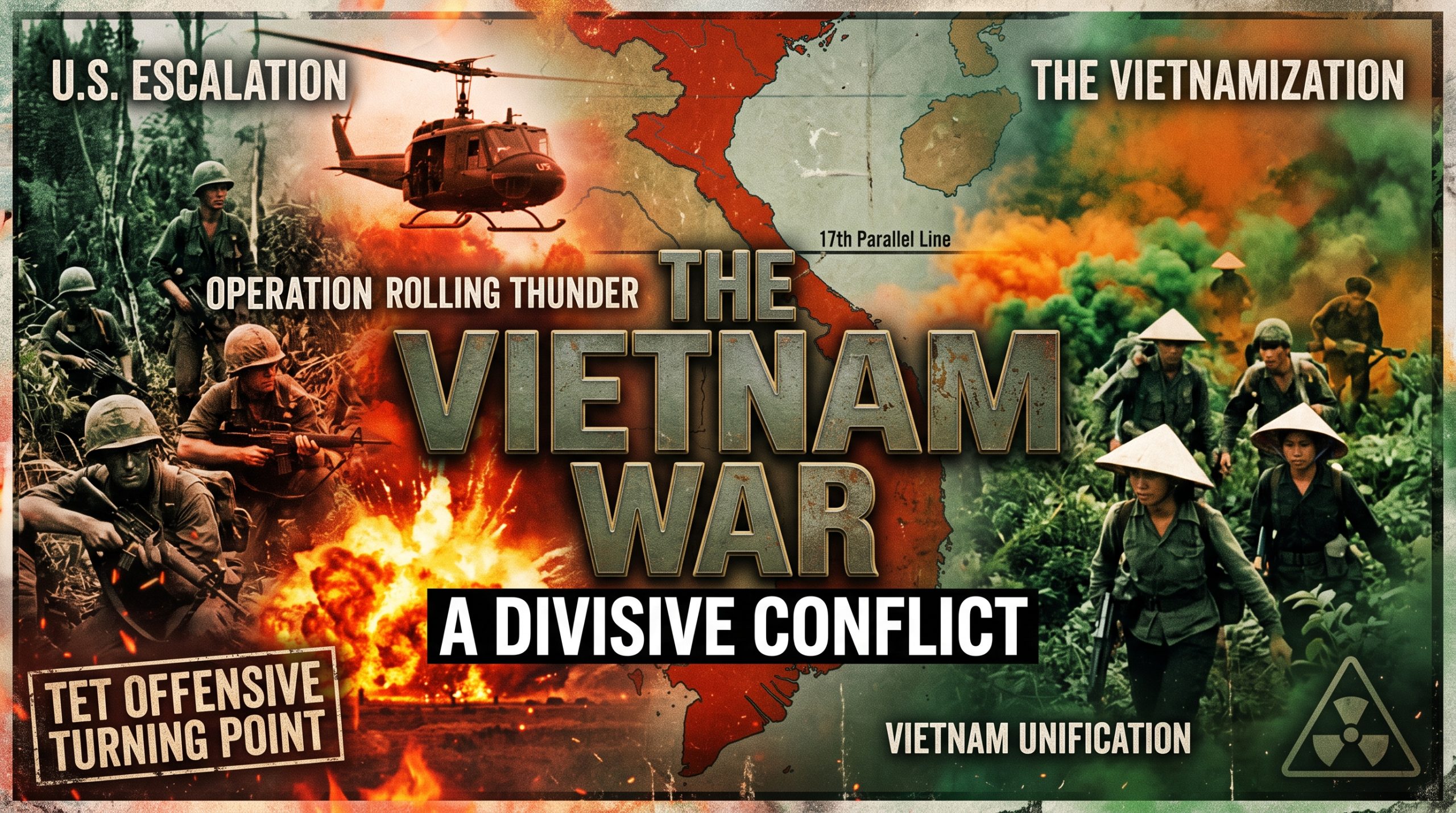

The Vietnam War was a divisive and complex conflict that pitted communist North Vietnam and the Viet Cong against South Vietnam and its principal ally, the United States. The origins of the conflict took root during an independence movement against French colonial rule, which ultimately evolved into a major Cold War confrontation.
Escalation and U.S. Involvement
The United States became directly embroiled in the war following the Gulf of Tonkin Incident in August 1964. Two U.S. destroyers stationed in the Gulf of Tonkin claimed they were fired upon by North Vietnamese forces, though reports later cast doubt on a second alleged attack. In response, Congress passed the Gulf of Tonkin Resolution, which authorized President Lyndon B. Johnson to take necessary retaliatory measures and served as the legal foundation for the U.S. to enter the war.
To combat enemy forces, the U.S. utilized extensive bombing and chemical warfare:
-
The U.S. launched Operation Rolling Thunder (March 1965 – November 1968), a major American bombing campaign.
-
The military also engaged in an aggressive program of chemical warfare codenamed Operation Ranch Hand.
-
This program used Agent Orange and other “Rainbow Herbicides,” which left a deadly and lethal legacy in the region.
Turning Points and Brutality
The war was characterized by intense violence and significant turning points that shifted the momentum of the conflict. In 1968, the North Vietnamese launched the Tet Offensive, a coordinated series of surprise attacks against more than 100 cities and outposts in South Vietnam. This massive offensive shocked the American public and deeply eroded support for the war effort.
The conflict was also marked by severe brutality and controversial battles:
-
In 1969, U.S. forces fought the Battle of Hamburger Hill, where they spent 10 days fighting to claim Ap Bia Mountain.
-
The intense sniper fire and violence led one soldier to dub the battle a “human meat grinder,” only for U.S. forces to abandon the hill days after taking it.
-
In 1968, infantryman Ron Ridenhour wrote a letter to President Nixon exposing the My Lai Massacre, an event where the U.S. Army murdered 500 civilians.
Domestic Opposition and the End of the War
Back in the United States, gifted photographers and reporters captured the agony of the war, driving deep divisions within American society. The escalating conflict empowered the hippie counterculture, which reached its height during the war and frequently engaged in acts of peaceful defiance, such as “Flower Power” protests. Additionally, secret government documents known as the Pentagon Papers, which detailed a highly classified study of U.S. political and military involvement, were prepared in 1967 and later brought to light involving figures like Daniel Ellsberg.
As the conflict dragged on, the U.S. implemented a strategy called “Vietnamization”. This aimed to reduce American involvement by transferring all military responsibilities over to South Vietnam. Ultimately, U.S. forces withdrew from the conflict in 1973. The war ended in turmoil with the Fall of Saigon, which culminated in the largest and most chaotic helicopter evacuation of its kind in history. Two years later, in 1975, Vietnam was officially unified under Communist control.