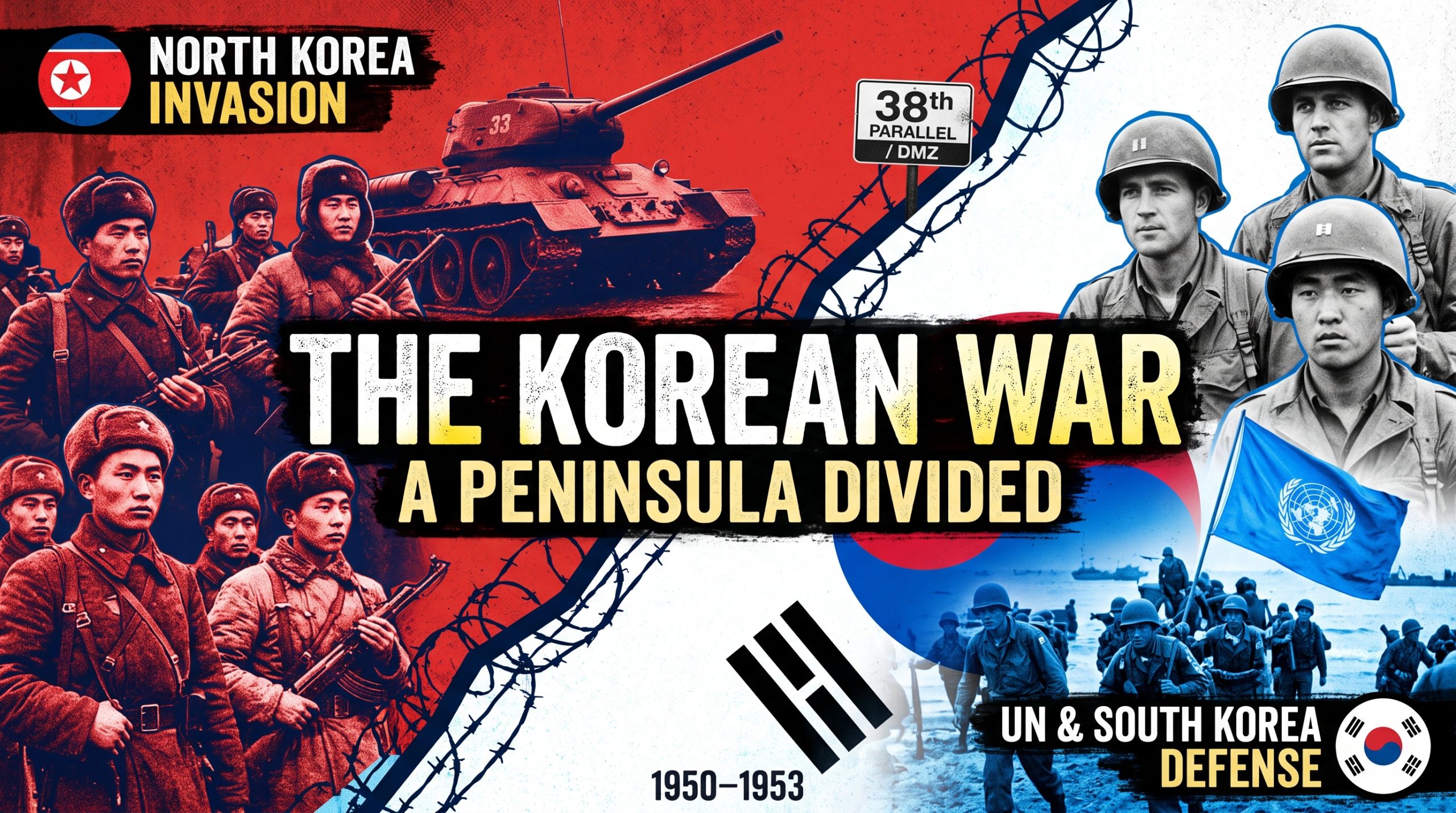

The Korean War (1950–1953) was a devastating conflict between the Democratic People’s Republic of Korea (North Korea) and the Republic of Korea (South Korea). It claimed at least 2.5 million lives and drew in major global powers, escalating into a massive international confrontation. The war left a profound legacy, cementing a division between the two nations that remains fragile to this day.
Origins and The 38th Parallel (1945–1950)
The conflict’s roots lay in the collapse of the Japanese empire at the end of World War II. Japan had annexed Korea in 1910, meaning there was no native government ready to assume power when hostilities ceased in 1945.
To disarm the Japanese and manage the territory, the United States and the Soviet Union agreed to temporarily divide the peninsula at the 38th parallel. The Soviets occupied the North, establishing a communist regime under the guerrilla leader Kim Il-sung, while the United States occupied the South, where the United Nations eventually sought to foster a democratic state.
In August 1948, the Republic of Korea (ROK) was established in the south with Syngman Rhee as president. Partisan warfare erupted along the border as Southern communists opposed the UN-backed state. Though the guerrilla uprising was contained, it claimed thousands of lives and set a violent stage for the full-scale war to come.
-Division of Korea
The Invasion and Counter-Offensive
Equipped and advised by the Soviet Union, and reinforced by Chinese veterans, the North Korean army had become a formidable force by 1950. In the early hours of June 25, 1950, they launched a thunderous artillery barrage and swept across the border. They captured Seoul within days, aiming for a quick surrender.
Instead of seeking a lengthy congressional declaration of war, US President Harry S. Truman immediately appealed to the United Nations. With the Soviet Union boycotting the UN Security Council at the time, the US successfully secured a mandate for military intervention. US General Douglas MacArthur took command of the newly formed United Nations Command (UNC).
Initially, the outgunned US and ROK forces suffered heavy losses, retreating southward while enduring massive civilian refugee crises. However, by August, UNC forces managed to hold a defensive line known as the “Pusan Perimeter” in the southeast. Aided by overwhelming air superiority, naval bombardment, and vital supply lines, the UNC halted the North Korean advance, turning the tide of the war before executing dramatic counter-offensives like the famous Inch’ŏn landing.
The Aftermath
The conflict dragged on for three brutal years, later drawing in a massive expeditionary force from the People’s Republic of China to aid the North. Despite the tremendous loss of life—including hundreds of thousands of Chinese soldiers and over 36,000 US service members—the war technically resulted in a stalemate.
On July 27, 1953, an armistice was finally reached. The peninsula was roughly restored to its pre-war boundaries, deeply divided by a heavily fortified Demilitarized Zone (DMZ). Because the South Korean government never formally signed the agreement, the Korean War technically never ended, leaving the two nations officially in a state of suspended conflict to this day.