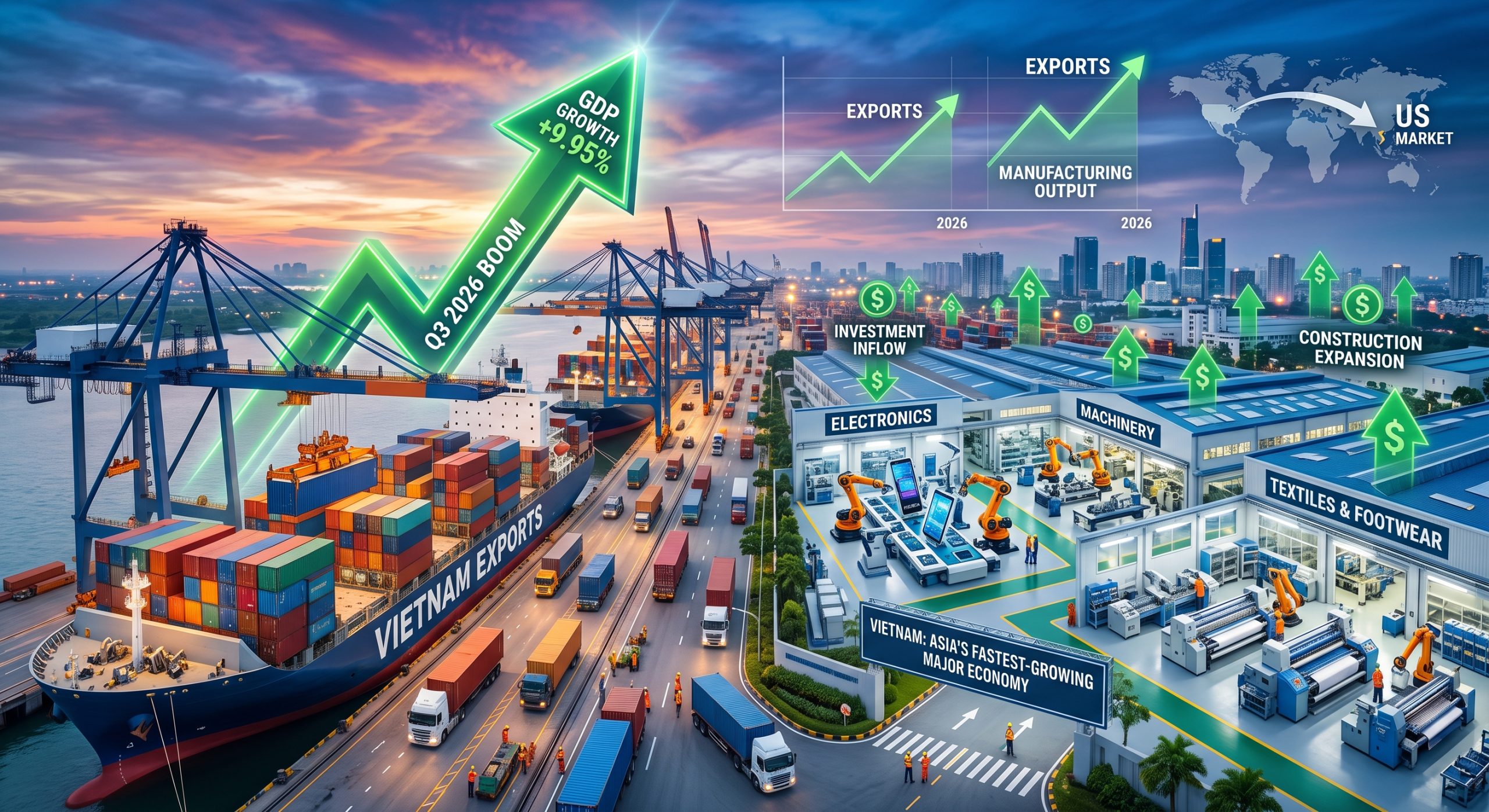

Vietnam’s economy accelerated sharply in the third quarter of 2026, with gross domestic product (GDP) growing 9.95% year-on-year, marking the country’s fastest quarterly growth in four years. The strong performance was driven mainly by booming exports, a rapid expansion in manufacturing and construction, stronger investment, and continued growth in services.
The latest figures help explain why Vietnam has become one of Asia’s fastest-growing major economies this year, although the country is also facing rising imports, inflationary pressures and uncertainty over global demand.
Exports provide a major boost
One of the biggest reasons behind Vietnam’s strong growth is the sharp increase in exports.
Vietnam exported $434.3 billion worth of goods during the first nine months of 2026, an increase of 24.5% compared with the same period last year. In the third quarter alone, exports reached $167.85 billion, up 30.4% year-on-year.
September was particularly strong. Goods exports reached $59.48 billion, up 39.1% from a year earlier. The United States remained Vietnam’s largest export market, accounting for around $140 billion of exports during the first nine months.
Vietnam has increasingly positioned itself as a major manufacturing and export hub for electronics, machinery, textiles, footwear and other manufactured products. Strong external demand therefore has a significant impact on domestic production, employment and investment.
Manufacturing and construction are expanding rapidly
Exports are closely connected to Vietnam’s industrial sector. During the first nine months of 2026, industry and construction grew 11.21%, contributing nearly half of the increase in the economy’s total value added. In the third quarter, the sector grew even faster, at 12.50%.
Industrial production also showed strong momentum. Vietnam’s industrial production index increased 12.3% during the first nine months, while third-quarter industrial production rose 14.8% year-on-year.
This means the export boom is not simply increasing the value of goods leaving Vietnam. It is also stimulating factories, construction, logistics and supporting industries inside the country.
Foreign investment is another important factor
Foreign direct investment (FDI) continues to play a major role in Vietnam’s economic expansion.
Registered foreign investment reached $50.36 billion by September 30, an increase of 76.4% from a year earlier. Meanwhile, realized FDI reached $21.07 billion, up 12.1% and the highest level recorded over the comparable five-year period.
Foreign companies have established extensive manufacturing operations in Vietnam, particularly in sectors connected to global supply chains. New investment can increase production capacity, create jobs and strengthen Vietnam’s role as an export platform.
Domestic demand is also supporting growth
Vietnam’s growth is not dependent entirely on exports. Domestic consumption and services have also expanded.
Retail sales of goods and consumer services increased 13.4% during the first nine months of 2026, reaching approximately VND 5,925.7 trillion. International tourism has also recovered strongly, with 17.7 million foreign visitors arriving during the first nine months, an increase of 14.5% year-on-year.
The services sector grew 8.69% during the first nine months, contributing about 45% of the increase in total value added.
Infrastructure investment is adding another engine
Investment has also helped accelerate economic activity. Reuters reported that robust infrastructure investment was one of the factors behind the strong third-quarter performance. Vietnam has been increasing investment in infrastructure and development projects, creating additional demand for construction, materials, transportation and related services.
Government data show that asset accumulation increased 21.39% in the third quarter, while total social investment during the first nine months reached about VND 3.11 quadrillion, up 15.1%.
But the growth also comes with challenges
Vietnam’s strong export performance has not translated into a trade surplus for the year.
Imports increased even faster than exports. During the first nine months, imports rose 36.7% to $453.72 billion, compared with 24.5% export growth. As a result, Vietnam recorded a $19.42 billion trade deficit, compared with a surplus during the same period last year.
Higher import costs, particularly for energy and production inputs, are putting pressure on businesses. Inflation is another concern. Consumer prices rose 5.08% year-on-year in September, according to data cited by Reuters.
The economy is also highly dependent on global demand. A slowdown in major markets could reduce orders for Vietnamese factories and weaken export growth.
Can Vietnam maintain this pace?
Vietnam’s GDP increased 8.15% in the first quarter, 8.81% in the second quarter and 9.95% in the third quarter. Overall, GDP grew 9.01% during the first nine months of 2026.
The government is targeting annual growth of more than 10%, meaning the economy would need another very strong fourth quarter to reach that goal. The Asian Development Bank has also maintained a more cautious outlook, with its 2026 growth forecast at 7.8%, highlighting risks from global demand and inflation.
Vietnam’s rapid growth therefore reflects several forces working together: strong exports, expanding manufacturing, rising foreign investment, infrastructure spending, domestic consumption and tourism.
The 9.95% third-quarter growth rate shows the strength of this expansion. However, the rising trade deficit, higher import costs and dependence on international demand mean that maintaining such rapid growth will remain a challenge.
For now, Vietnam’s economic model—combining export-oriented manufacturing with increasing foreign investment and domestic consumption—is producing exceptionally strong headline growth in 2026.