
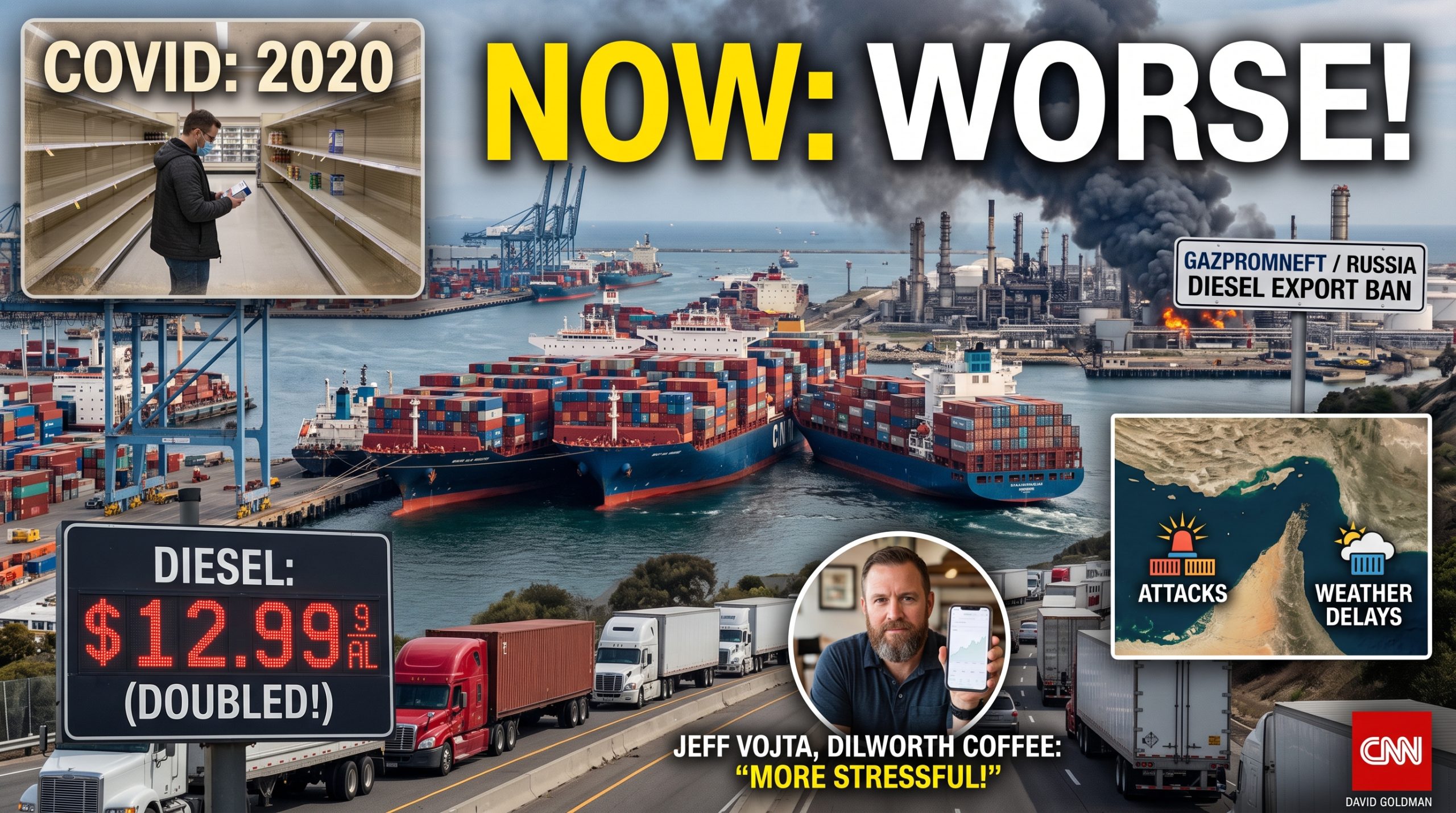
American business owners are struggling to navigate a historic supply chain crisis that many are now calling worse and more complicated than the disruptions seen during the COVID-19 pandemic. Facing extreme volatility, massive disruptions, and price instability, businesses are finding it nearly impossible to plan for the future or pass mounting costs onto inflation-weary customers.
A Perfect Storm of Global Crises
The current economic climate is being battered by a compounding series of global emergencies, driving up costs across multiple industries. Diesel fuel prices have doubled since March, fueled by an escalating war with Iran, ongoing Ukrainian bombardments of Russian oil refineries, and a Russian export ban that has effectively removed 12% of the world’s seaborne diesel supply.
Shipping and logistics have also taken a severe hit. In the Red Sea and Gulf of Aden, the resurgence of Houthi rebels and Somali pirates has forced commercial ships to reroute entirely around the African continent, a detour that has slashed global shipping capacity by 15% this year. At the same time, extreme weather events tied to a Super El Niño have devastated agricultural yields, such as coffee crops in Brazil and Vietnam, while back-to-back typhoons essentially shuttered the Port of Shanghai—the world’s largest container port—for two weeks. Compounding the pressure, newly imposed global tariffs by the Trump administration have driven the cost of imported goods even higher.
Extreme Volatility Replaces Pandemic Halts
While the COVID-19 pandemic caused the supply chain to effectively halt, experts warn that today’s crisis is driven by intense, unpredictable volatility. Shipping networks now rapidly stop, start, and bottleneck, while raw material prices repeatedly spike and plummet. Small business owners note that while the supply chain is technically functioning, it is doing so with drastically higher costs, friction, and uncertainty.
The Path Forward
President Donald Trump has framed the economic turmoil as a temporary issue, stating that oil prices will “drop precipitously” and inflation will reverse once the war with Iran is resolved. However, supply chain experts and business leaders remain highly skeptical. Even if the geopolitical conflict in the Middle East were to end immediately, it would not undo the severe weather disruptions, restore the blockaded Russian diesel exports, or quickly bring down the sticky price hikes in the service sector.